Despite having visited most of Central Europe in the past, this trip would be my first time visiting Germany. A few weeks ago we had dipped into Hamburg for a brief two days. However, as we were staying with family in a rural village and only went into the city on a Sunday (when everything was closed) I didn’t feel like I had experienced Germany proper. So I was extremely excited to go to Munich and try again.
There’s no more expensive time to visit Munich than late September/early October, when we did. Of course, like every man and his dog, we wanted to do Octoberfest, so we had to go then. Hostels were upwards of €100 per night, and even camp grounds were about €50. But thankfully, we were saved by the grace of Nancy and Moritz, Finn’s family friends who agreed to let us and two friends stay for five nights.
I ended up loving the place, and not only for Octoberfest. I felt like we had a veritable insight into Munich life thanks to Nancy and Mortiz’s hospitality. From my experiences there, Munich is a city that feels safe and cozy. It has loads going on yet it’s not too loud and chaotic. Like New Zealand, Munich feels small, clean, and connected to nature, while still maintaining the buzz of being a major European hub. There’s a great balance about the place that I think will be hard to beat when I visit other cities in Germany.
So without further ado, here are my top 5 reasons (and of course there are many more) why I had such a great time visiting the Bavarian capital:
- The people
For some unknown reason, there is a stereotype that people from Munich (Müncheners?) are snobby or unfriendly. We did not find that to be the case, even during Octoberfest season which is undoubtedly the busiest and most annoying time for the city. Everyone was very lovely and helpful, especially our hosts, who went out of their way to ensure we had the best experience of Munich.
As educators, Nancy and Moritz had some time off work while we visited, so we were able to spend a lot of time with them, having meals together, exploring the city, and of course visiting the festival. We also met their two sons, including one who was able to get us a highly-sought after table at the festival, since he was working the season as a waiter!
The whole experience was also, of course, improved by the company of Thomas and Alyssa, our friends from Christchurch who met up with us for the week. It was so lovely to see them again after six months, and they even brought a slice of home with them in the form of Whittakers chocolate! After having spent so much time surrounded by people we only just met, it was an enormous relief to hang out with people we’d known for years- it was like we could truly kick back and have fun.
We kicked off our time in Munich with a visit to the Englischergarten, one of the largest city parks in the world, bigger even than Central Park. We watched people surfing the river before sitting back and enjoying a picnic of pretzels and Augustiner beer in the sun. At that moment I realised just how awesome this week was going to be.
- Bavarian Traditions
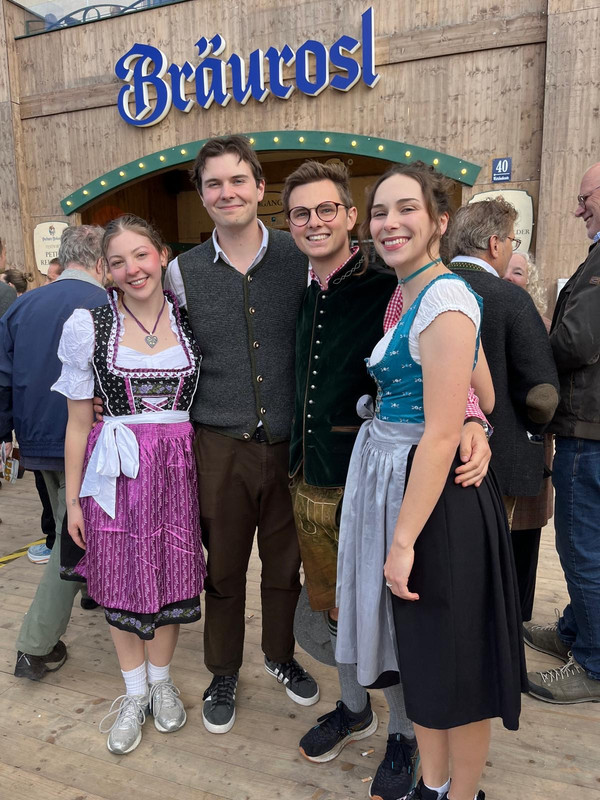
Once we all got together, eaten, and settled in to the house, the first order of business was finding appropriate Octoberfest attire. Now there’s no dress code for the festival, you can wear whatever you want, but of course half the fun is dressing up in traditional German outfits. This didn’t used to be the case though, as Nancy and Moritz told us that it’s only become popular to go for the full traditional outfit recently, probably with the rise of social media. But nevertheless, I’d been dreaming of this moment for years, so there was no way in hell I was passing up the full Monty.
The outfit I’m referring to is known as a dirndl: your classic lace-front dress with a blouse and apron. For men, there are all sorts of lederhosen to choose from- those are the leather pants, traditionally made from deer hide. You can get them in brown, white, black or grey, in short, long or 3/4 length, with or without braces. Dudes who opt for the full fit will pair their lederhosen with Haferlschuh (suede shoes), Loferl (woolen calf warmers- I’m not kidding), a vest and perhaps a Bavarian hat.


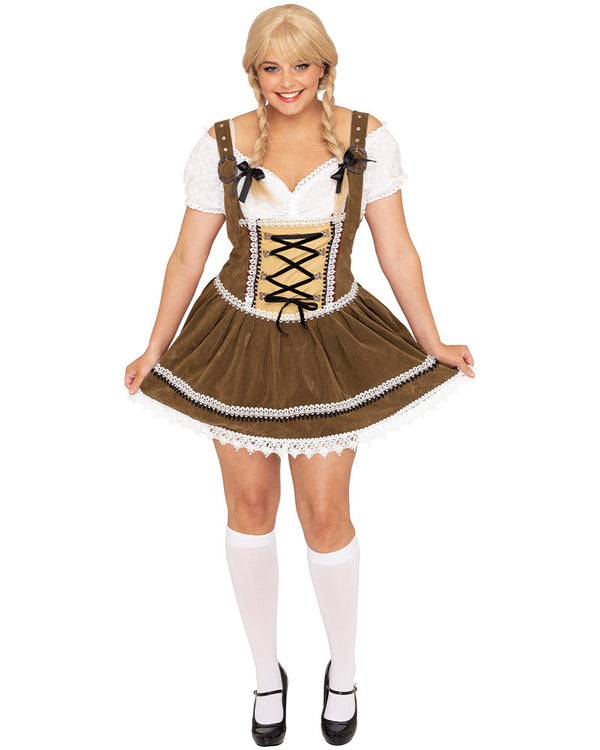
The difference between a real Dirndl and a costume (not my images)
These trachten (outfits) aren’t only for Octoberfest either. Lederhosen and dirndl are considered normal formal attire, suitable for any formal event from a graduation to your wedding. Think of it like the German’s version of a Scottish kilt.
Luckily, Moritz had a spare pare of lederhosen Finn could borrow, but I was in need of a dirndl.
There were plenty of pop-up dirndl stores around Munich, so I thought this would be easy. But in closer inspection, and consultation with Nancy, I realised that these were cheap costumes, going for about €40 plus a blouse for another €20. They were low quality, made of a shiny plastic rather than wool, and you could see it a mile away. And while they were certainly more catered toward my budget, these often super short dresses are essentially turning a centuries-old cultural tradition into a Halloween costume. It just didn’t feel right to me. So to be respectful to locals and the Bavarian culture at large, I decided to look for something authentic.
But the problem was a new dirndl from a real shop goes for €150 at the CHEAPEST. Now here’s the debate. Without buying a costume version, how can I buy a Dirndl cheaply, considering I will probably only wear this a few times? I definitely should have budgeted for this ahead of time. I looked into renting one, but it was looking to be €50 for one day, or €100 for three, which was probably how many times we would go. It making me cringe. Alyssa and I visited countless second hand stores looking for something we liked, but since we were toward the end of the festival, the lot had been thoroughly picked through. We each found one that was okay, we would settle for it if we had no other option, but we were not at all excited by the prospect.
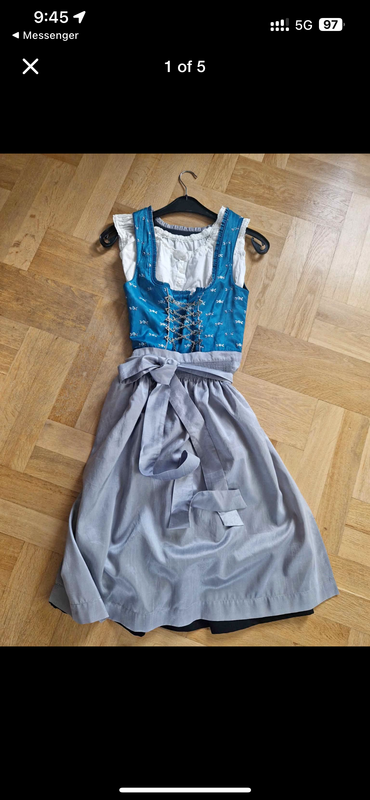
So I prayed to the gods of Facebook Marketplace and something pulled through. I landed on a teal blue dirndl that I actually liked and was a high quality brand (Angermaier). It cost €70 including the blouse and apron, so only €10 more than the cheapest costume and much cheaper than a rental. I was stoked. Finn and I caught the train north to pick it up.
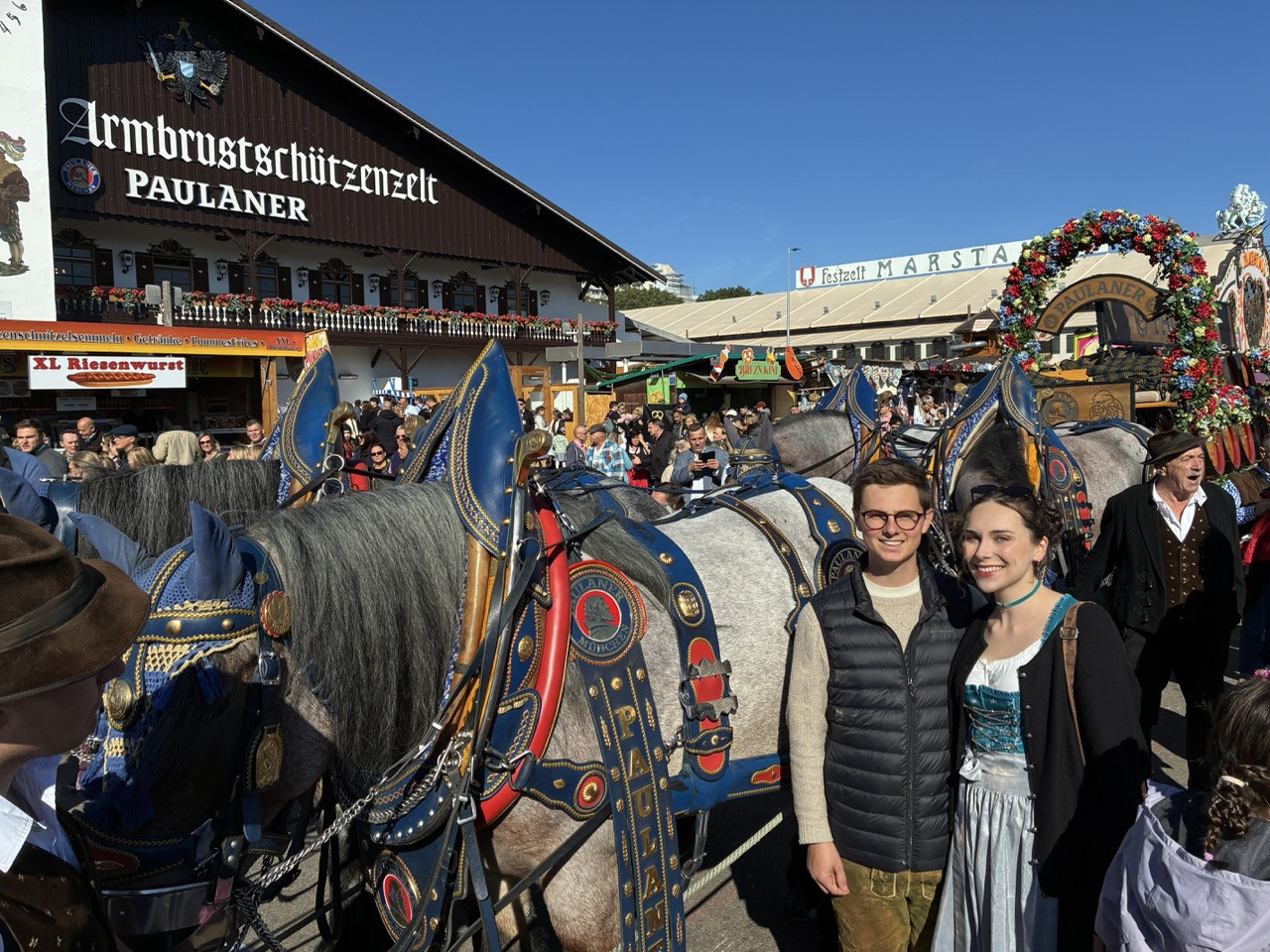
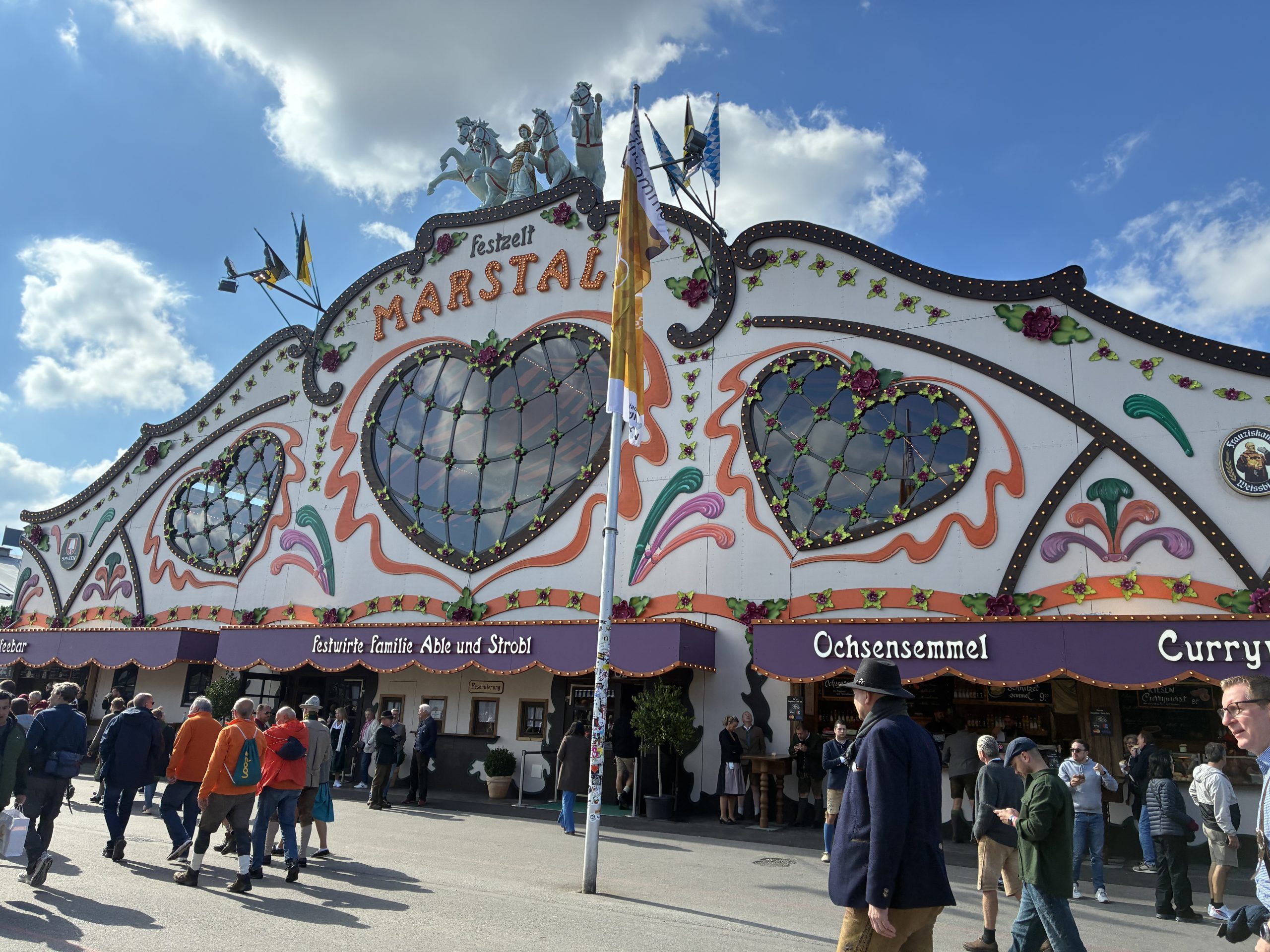
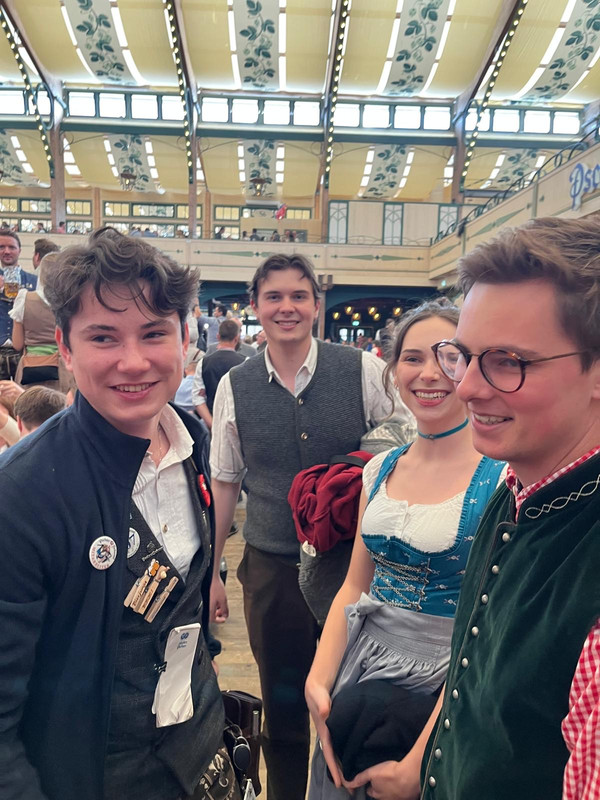
That evening, we went to the festival. It’s free entry, which was a welcome relief to my bank account. As we got closer and closer to the entrance, more festival goers joined us until we were like a swarm of beer-thirsty bees. The site itself was massive. Much bigger than I was expecting- about 42 hectares according to google. The star of the show, of course, were the 14 main Beer tents, each the size of a two story building. In addition, there were about 30 smaller tents, and enough food stalls, drink stands and funfair rides to fuel a city. The skyline was marked by full on roller coasters, two big spinny-drop-tower-rides, and an 18-metre tall statue of Lady Bavaria (essentially Munich’s Statue of Liberty). At night, the whole place light up like a chandelier. It was a sight to behold.
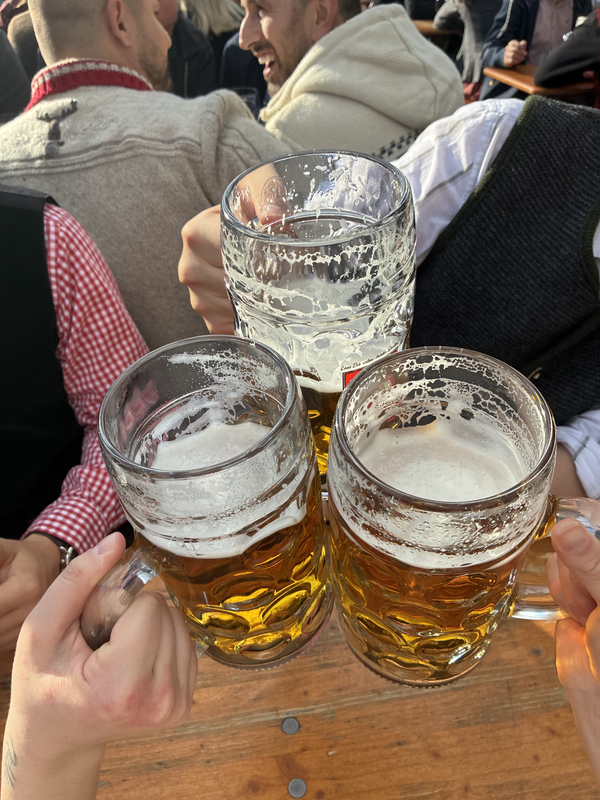
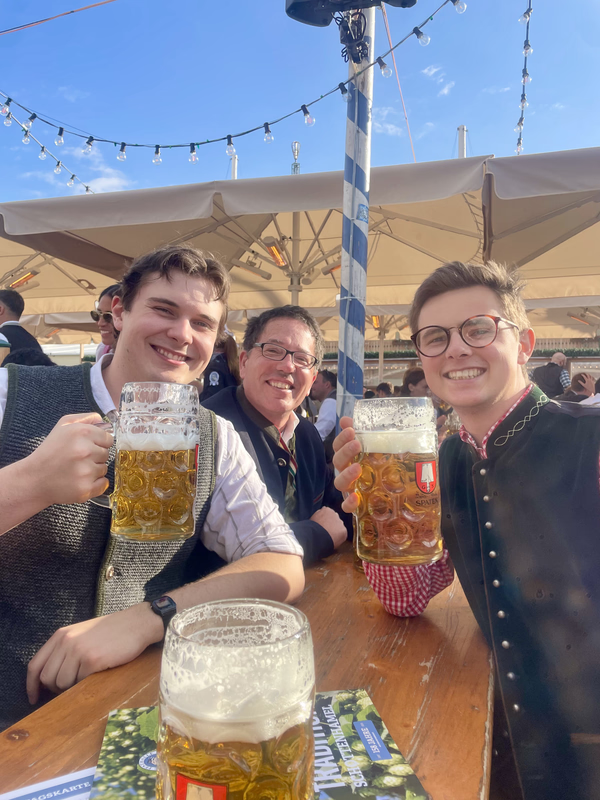
Of course, we saw it as our duty as visiting reporters to familiarise ourselves thoroughly with the inside of a beer tent. Each tent is named after a different Munich brewery, and you can only buy that kind of beer there, for example Hofbräu, Paulaner, Augustiner and Löwenbräu. We spent most of our time inside Pschorr-Bräurosl (a brewery I had never heard of before then) because Sandro could often get us a table.
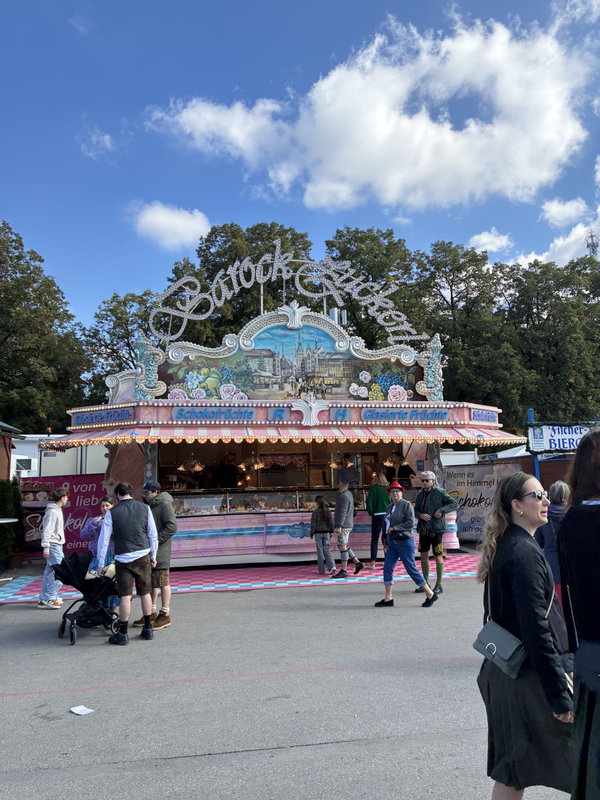
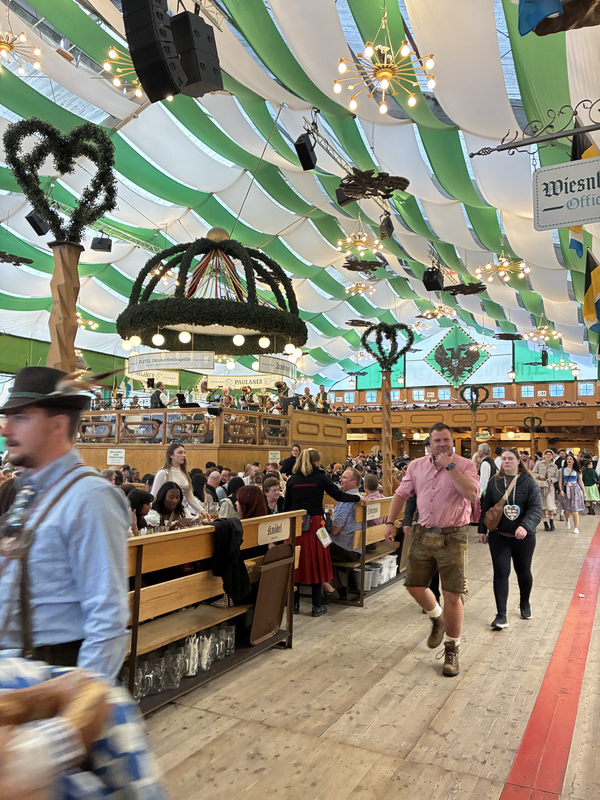
I don’t think it’s fair to call this construction a “tent” because that implies it is small, flimsy and full of insects. In reality, it was big enough for about 6,000 people, built over two stories using proper wooden beams and German engineering. The only aspect that felt like being in a tent was the occasional drip of condensation from the ceiling onto my head. But with 6,000 people chanting, dancing, sweating and drinking, I suppose this is to be expected. Speaking of the ceiling, by the time we arrived toward the end of the festival, it was covered in escapee helium balloons.
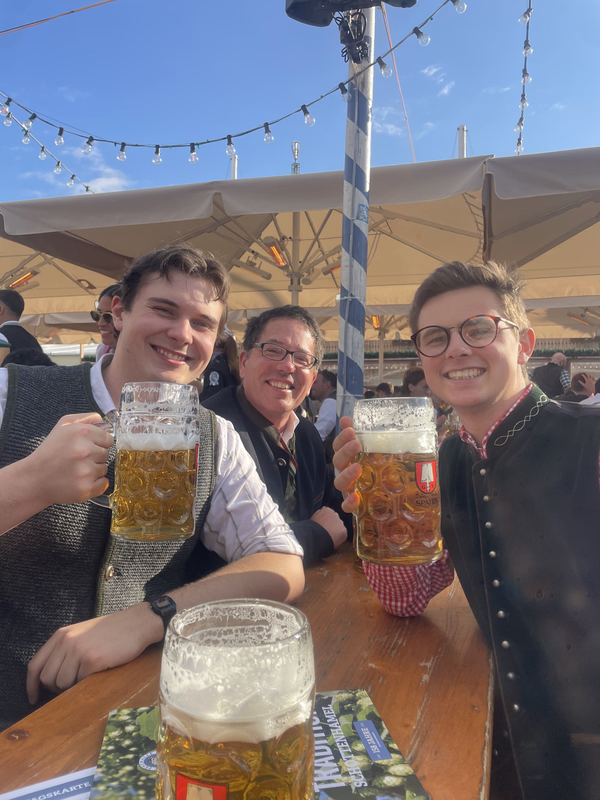
The tents were filled with long benches separated by narrow aisles. Everyone wanted a seat, because you could only get served if you were sat at a table. But that didn’t deter people from filling the aisles while waiters pushed through carrying five Mas of beer in one hand and a large tray of roast ox in the other. According to the organisers, about 6.5 million litres of beer, 500,000 roast chickens and 125 oxen. A mad of beer (which was 1L, so a bit more than 2 pints) cost €16 + tip.
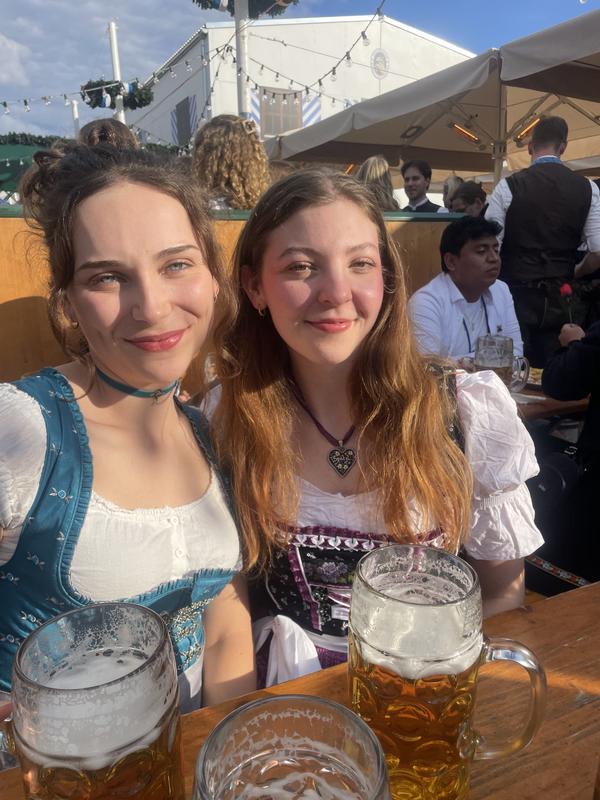
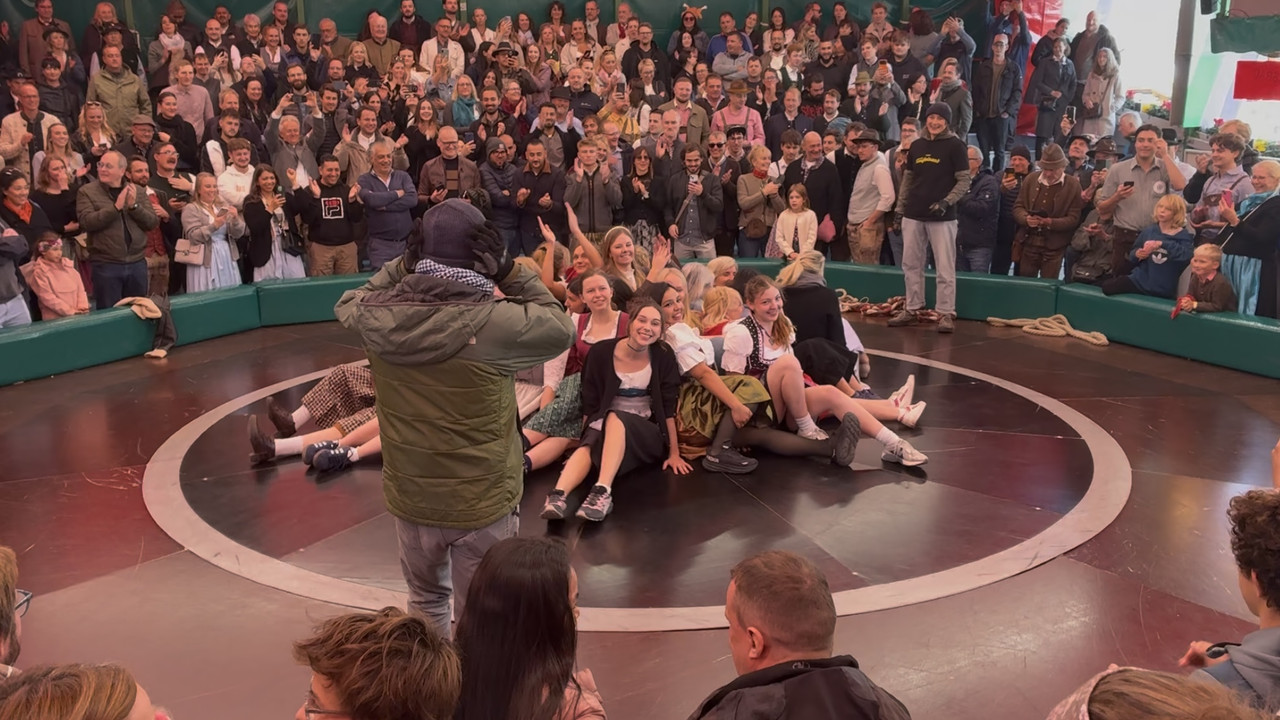
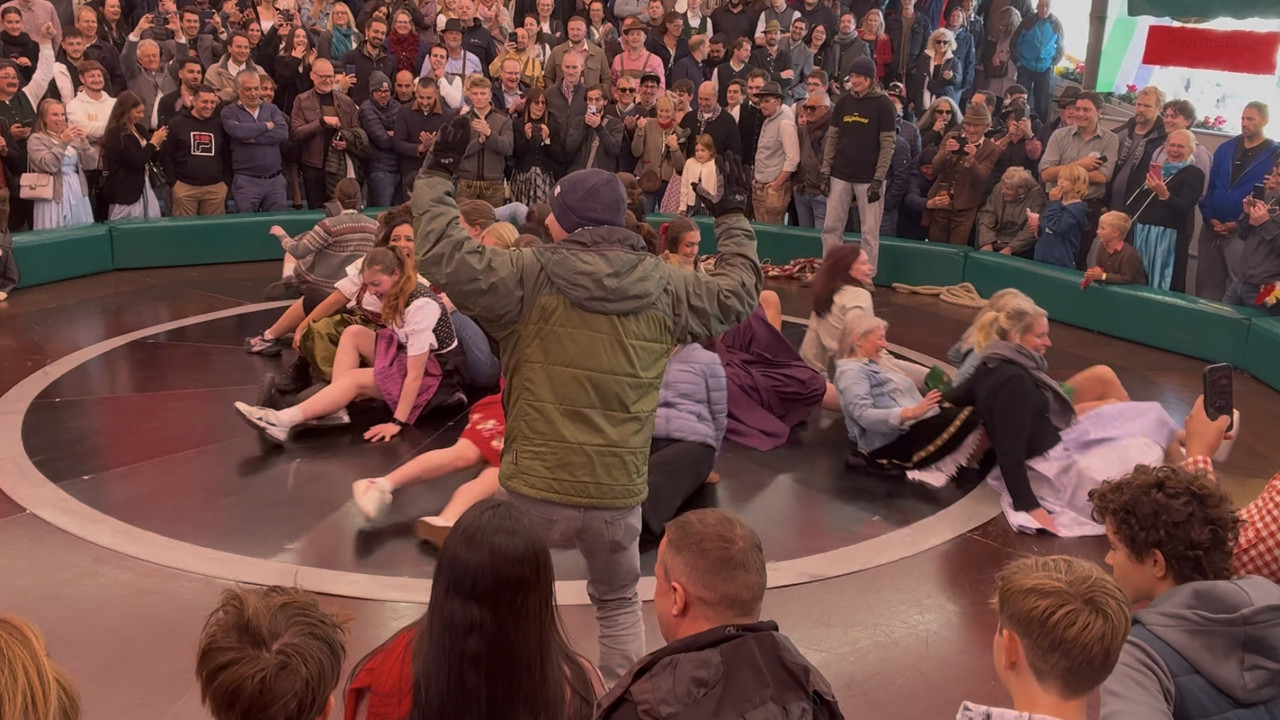
Other than drinking beer and singing songs, we wandered around the festival grounds and participated in some traditional games. We entered this one tent which contained two sets of bleachers looking down onto a spinning disk in the middle of the floor. It was shaped like a low cone, slightly raised in the middle. Known as Feldl’s Teufelsrad, or the Devil’s Wheel, the concept is super simple but super fun. To start the game, there are two managers who will call out a category of people to come and participate, for example, “kids between 8-14” or “men wearing lederhosen”. People in that category leap over the barriers and race to get a spot on the wheel, as close to the centre as possible. The goal is simply to remain on the wheel- the last person remaining wins. But this gets progressively harder, as the wheel gradually increases speed and the centrifugal force tries to fling you off the sides. If you survive the speedy spinning, the next stage is to introduce a soft wrecking ball, which swings back and forth, knocking people in the head and pushing them off balance. If you can withstand that, the managers take matters into their own hands, flinging long ropes to tangle you up and pull you off. It’s a great spectators sport. I remained on the wheel for what I thought was a respectable amount of time, before getting spectacularly flung off, so dizzy I couldn’t walk straight. Good thing this was before the beer. Thomas and Alyssa also had a go, but unfortunately Finn’s category didn’t get called.
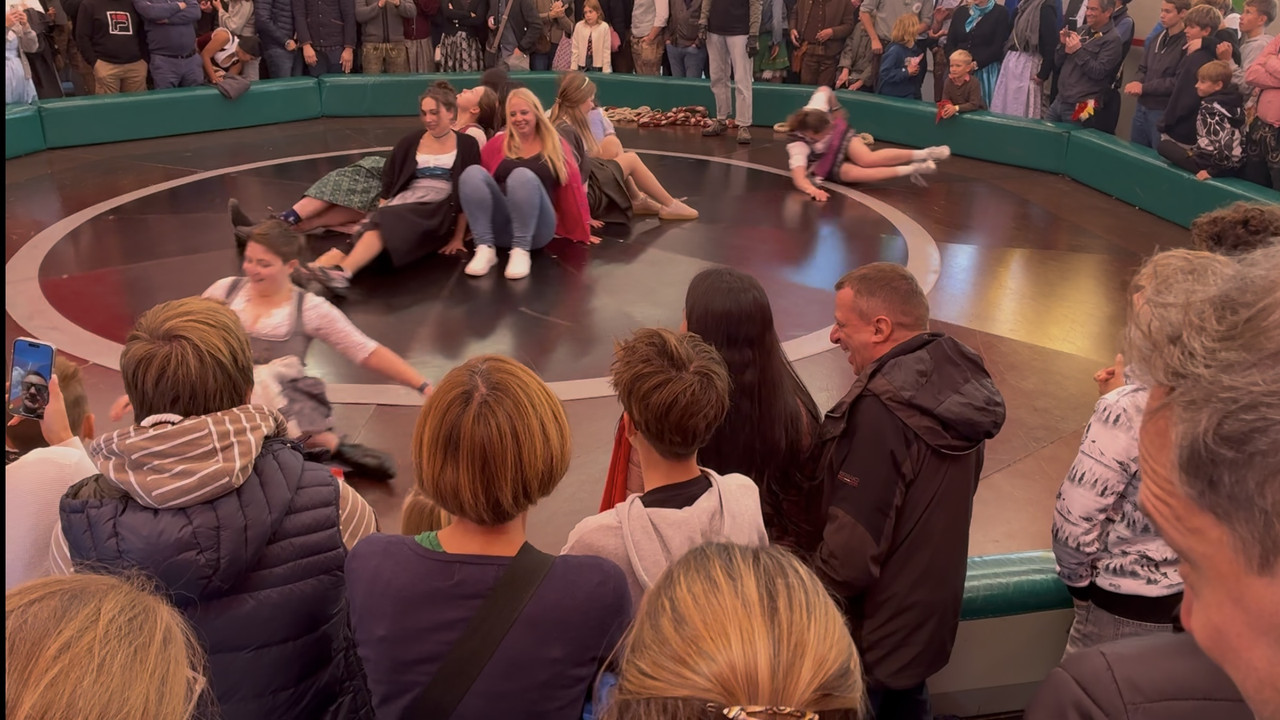
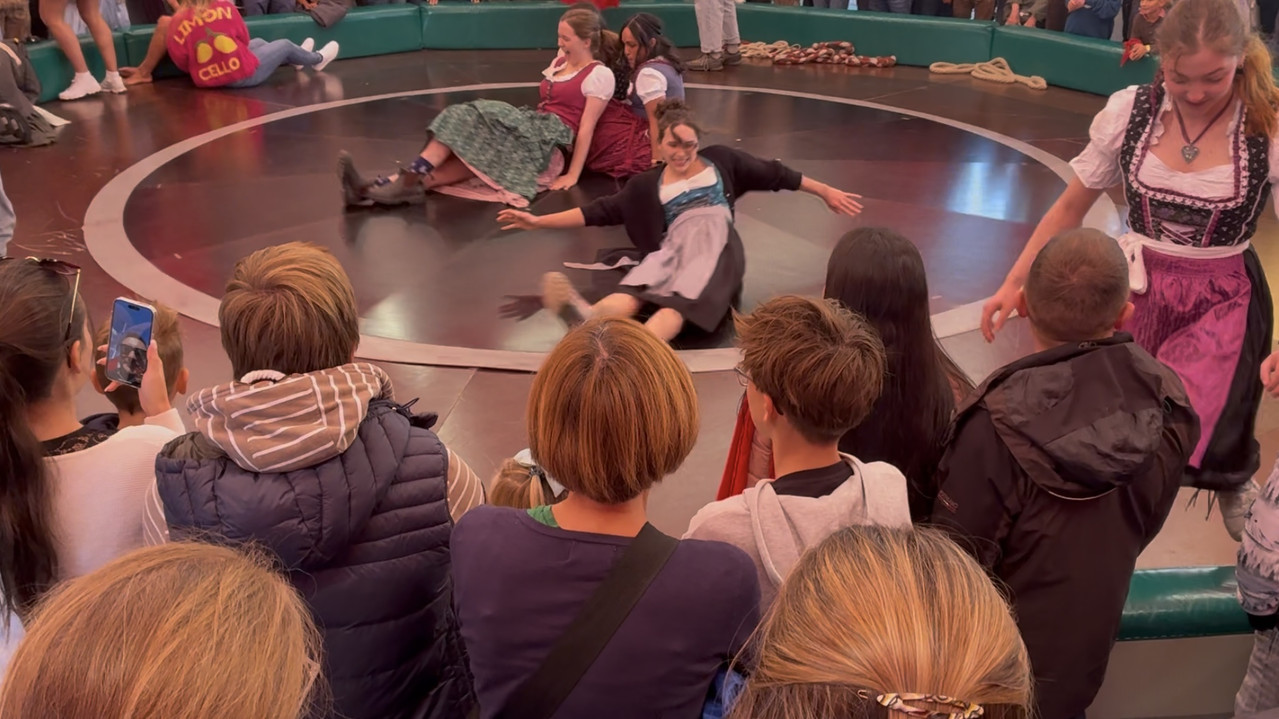
We had a blast at the festival, and returned again twice more. While it certainly felt touristy, I am happy to report that the Bavarian tradition was very strong as well. It still felt authentic, we met many Germans who love to go every year, often attending at least half a dozen times while it’s on. In my opinion, Octoberfest definitely lives up to the hype, especially if you attend with a great crowd like I did.
- The Food
One thing I’ve learnt since visiting Germany is that apart from pretzels, there’s no such thing as “German food”. You have to be much more specific than that. The differences in cuisine, culture, and even language are vary hugely from region to region. So don’t greet with “moin” and ask for a “brötchen” if you’re in the South, you ought to say “servus” and tell them you want a “semmel”.
I was incredibly impressed by the unique food that Southern Bavaria had to offer. I had an awesome medley of three iconic foods in one when Nancy and Moritz took us to a traditional Bavarian restaurant: Jäger schnitzel with Käsespätzle and Knödel.
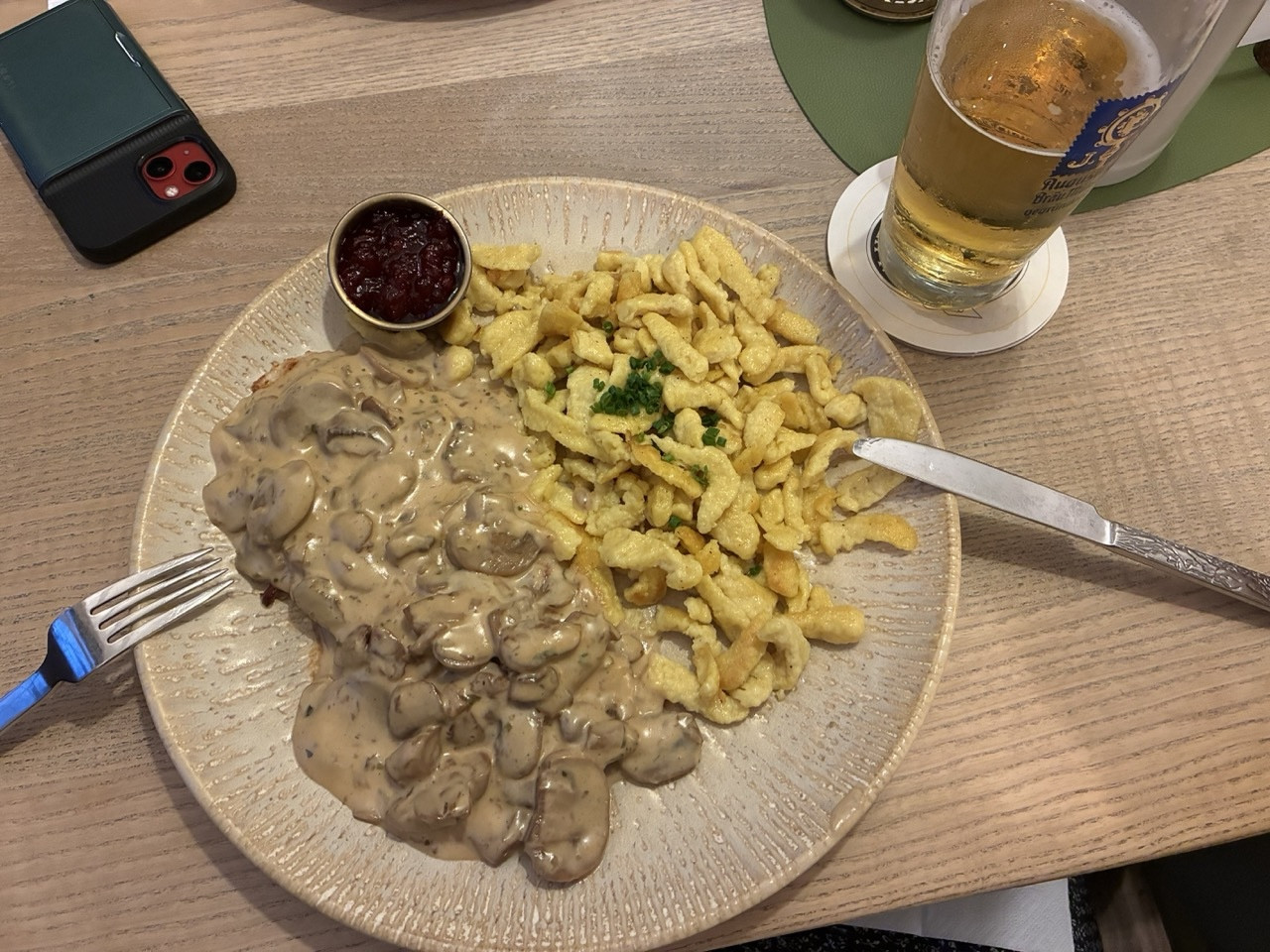

Jäger (hunter) schnitzel is a classic kind of schnitzel that is served with mushroom sauce. Not crumbed, it is traditionally veal but nowadays is often pork.
Spätzle is… harder to explain. It’s a kind of egg-based pasta that has been pressed into stubby noodle shapes and boiled in water. It looks kind of like macaroni, just solid. You can have it as a side dish to soak up all the mushroom sauce, or on its own, often with cheese (Käse).
Then we tried two different kinds of Knödel. This translates directly to “dumpling”, but I think that’s misleading. Knödel are golf-sized balls of dough without any filling inside. We had one made of potato (Kartoffelklöße), that had a gelatinous texture that I found rather odd. The other was made from leftover pretzels (Brezelknödel), containing chunks of pretzel cemented together with a flour-water dough. I enjoyed this one significantly more. You can also get Semmelknödel made from bread.
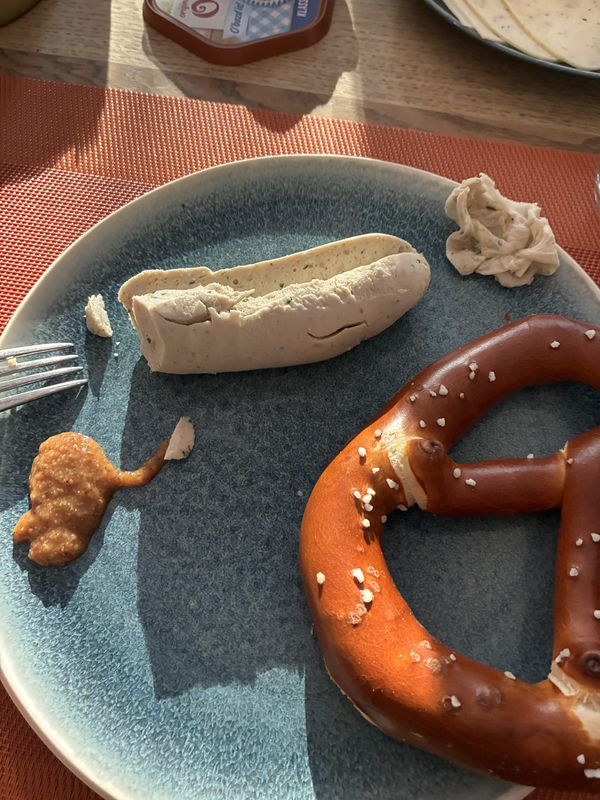
Nancy and Moritz also let us try Weißwurst (white sausage) a classic Bavarian breakfast sausage strictly served in the morning. It has a white appearance because it’s not smoked or cured. I had to google what it’s made of because I realised I wasn’t sure- Google says Weißwurst is “made from finely minced veal and pork back bacon [whatever that is], seasoned with parsley, lemon, mace [wth is mace?], onions, ginger, and cardamom”. It takes brilliant, especially with sweet mustard and a pretzel, though there is some skill required to peel off the casing using your knife and fork.
This pic is Weißwurst with sweet mustard and a pretzel- yum!
For breakfast we also had Obatzda, a spreadable amalgamation of Camembert, butter, cream and onions to be enjoyed like cream cheese. We also tried Rotkohl (red cabbage), braised with apples and vinegar, which surprisingly was supposed to be served hot. It had an interesting taste that was both sweet and sour.
- The Activities
Even excluding the festival, there was so much to do in Munich. We were treated to a city tour à-la Nancy, where we got to see the top sights, including Marienplatz, the park of the 1972 Munich Olympics, and Allianz stadium. We stopped into Nymphenburg palace, an enormously grand castle from the 17th century, and strolled around the extensive gardens. I appreciated the resident swans as well as the European Rococo hunting lodge Amalienburg. In the home city of BMW, we of course had to stop into the BMW World museum to have a geeze at some cars and stuff.
A highlight of our trip so far was definitely our visit to Neuschwanstein castle, (pronounced Noy-shvarn-shtein) about an hour and a half south of Munich. This was the most magical looking castle I’ve ever seen, and I’ve seen quite a few. It was incredible. Neuschwanstein is often thought of as the inspiration for Disney’s castle logo- it’s a classic romantic image of a castle with pointed turrets.
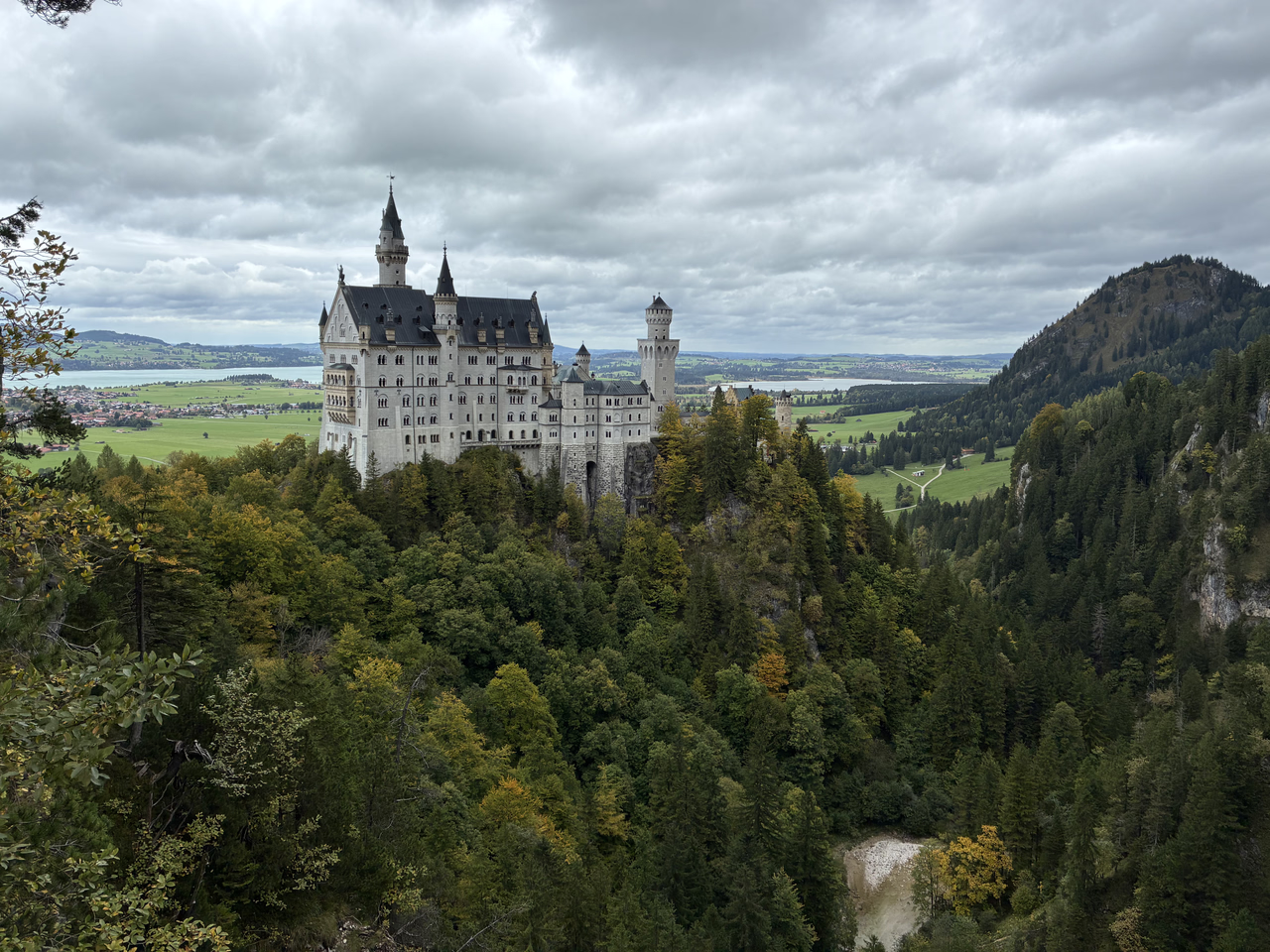
Neuschwanstein is not as old as it looks. It was commissioned in 1869 in imitation of fantasy medieval-style castles. This was the brainchild of King Ludwig II of Bavaria, a fascinating and slightly crazy fellow, who was obsessed with an aesthetic escape into middle-ages fantasy. A romantic idealist, his architectural decisions were greatly inspired by the operas of Richard Warner. It was built to be a private refuge in the remote northern fringes of the Alps, near his late father’s castle and Hohenschwangau. It was entirely funded by Ludwig’s personal inheritance, rather than state funds.
Unfortunately, Ludwig passed away under suspicious circumstances before he could see the completion of his masterpiece. Shortly prior, Ludwig’s introversion (and probably autism) caused him to be accused of insanity and declared mentally unfit to rule. He was imprisoned at Berg Castle. The next day he went out for a lake-side walk to discuss his internment with his doctor, who had declared him insane without so much as an examination. Ludwig was found dead in the water a few hours later. His death was ruled suicide by drowning, though this seems improbable considering there was no water in his lungs, he was a strong swimmer and the water was less than waist-deep. His doctor was also found dead a few hours later, with evidence of blows to the head and marks of strangulation. Some people speculate that a struggle broke out when Ludwig attempted to escape, resulting in both their deaths.
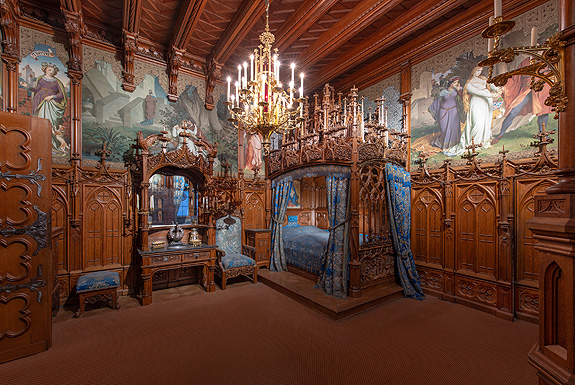
We paid about €24 each for a tour of the inside of the castle, which is the only way to gain entry. It was more money than we would usually spend, but I’m grateful we did because it was possibly the most beautiful castle interior I’ve ever seen. I would even put it above Versailles, which although magnificent, is over saturated by the maximalist baroque style. In contrast, Neuschwanstein’s interior was an artistic masterpiece, created highly skilled craftsmen- opulent without just throwing gold at everything. Unfortunately it was forbidden to take photos but I’ll try find some online.
A highlight for me was the throne room, rather small and therefore more symbolic than useful, which was framed by the most magnificent painting. It was an incredibly romantic, angelic image of a green leafy forest, featuring dappled light and tiny little creatures like squirrels and birds. Our guide told us this was Walt Disney’s inspiration for the forest in Bambi. I also adored the King’s bed, a four-poster woodworkers masterpiece topped with the most intricate wooden carvings I’ve ever seen. Underneath, a night sky was painted. And as if this couldn’t be romantic enough, the stars were actually tiny holes which would twinkle with candlelight from candles lit in a chamber above the bed. It was magnificent.

We were supposed to tour the castle at the same time as Alyssa and Thomas, but when they went to book, they couldn’t find the same time slot as us. Assuming it had been booked out, they reserved a later slot and it was decided that we would all drive together and take turns doing the tour. Finn and I went first and loved Neuschwanstein castle. It was only once Thomas and Alyssa had returned from their later tour that we found out they had had a totally different experience!
They had got as far as the front gates of Neuschwantein, presented their tickets, and were told that they had actually purchased tickets for a different castle altogether- Schloss Hohenschwangau. Luckily, this castle was just down the road, but Thomas and Alyssa had to sprint full speed for fifteen minutes down the hill to reach it in time for their tour.
Hohenschwangau is the older castle in Füssen (the name of the area literally translates to “feet” by the way). It was the castle of King Ludwig II’s father, where Ludwig fell in love with the region and was inspired to build Neuschwanstein. Thomas and Alyssa highly recommended it as well.
- The Location
Munich, like Christchurch, possesses one of my favourite qualities of a big city- an excellent proximity to natural wonders for hiking, skiing and swimming. Residing in the deep south of Germany, Munich has easy access to the alps. Lake Constance is just over 2 hours away for swimming, cycling and water sports. Zurich is only 3 and a half hours away, and in under 4 hours, you can get to either Strasbourg, France or Prague, Czechia.
Thomas, Alyssa, Finn and I took it upon ourselves to do a quick trip to Austria, when while were headed to Neuschwanstein nearby. We borrowed Nancy and Moritz’s BMW convertible and took to the autobahn. We could have gone to Salzburg, a historic town right near the border, but since we were visiting Neuschwanstein we had gone in the opposite direction. So instead, we dipped into a part of Austria where there is nothing, except part of Germany’s largest mountain Zugspitze. So we drove around the base of the mountain, blasting music with the top down, even though it was freezing cold.
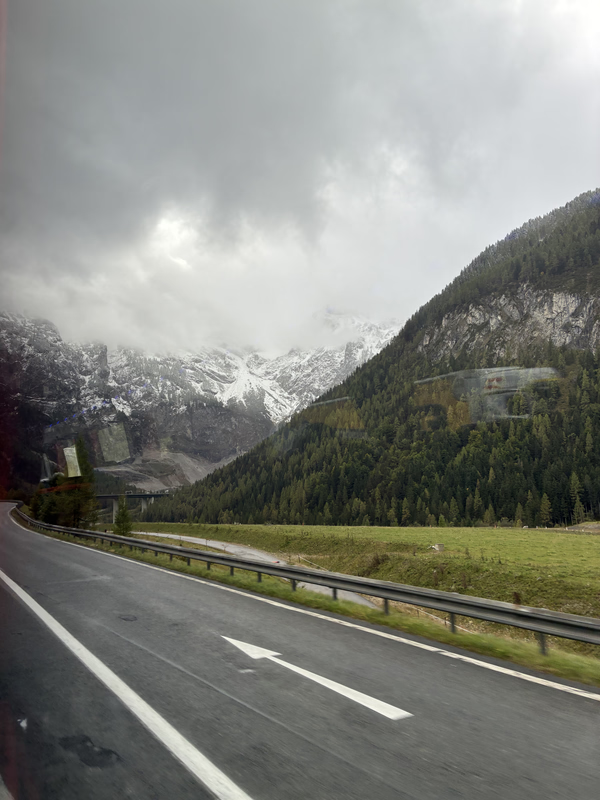
There was something so perfect about that drive, being in another country without ever having to show your passport. It’s crazy how quickly you can go from a busy city center to somewhere that feels completely remote. That’s the beauty of Munich’s location. You’ve got the Alps right there for skiing or hiking, lakes everywhere for summer swims, and half of Europe within a few hours’ drive or train ride. You can wake up with no plan and end up in Austria by lunch or Italy by dinner. It makes the city feel open and connected, like adventure is always just around the corner.
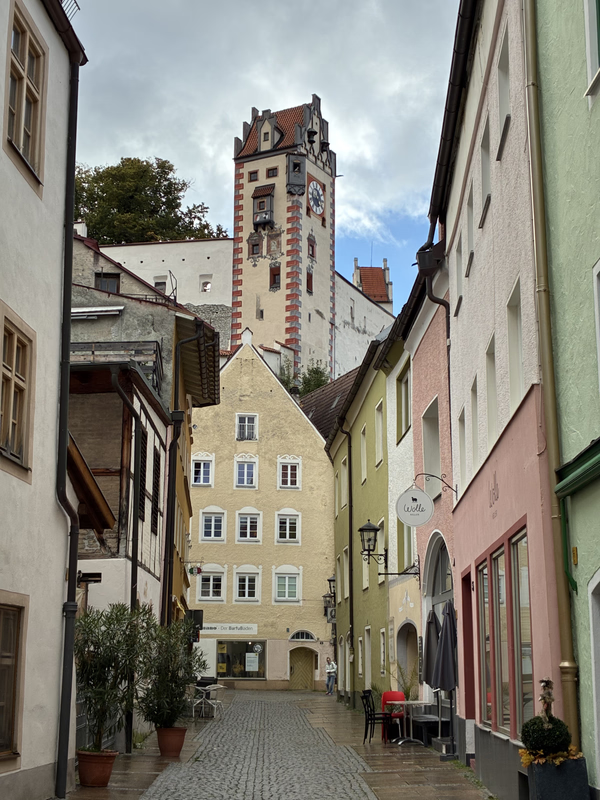
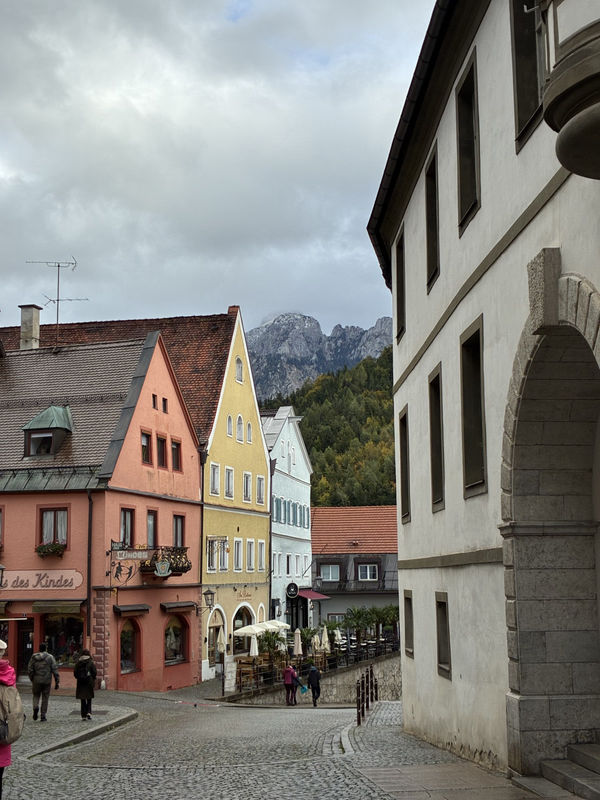
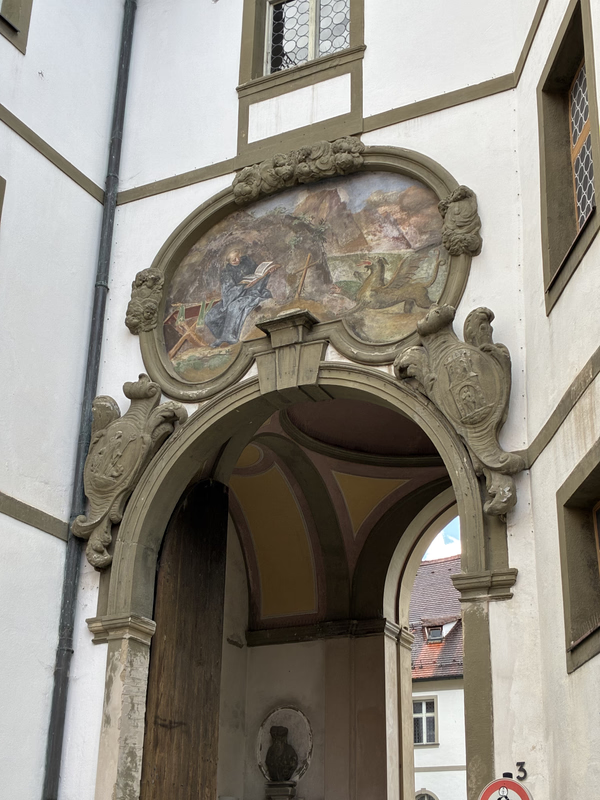
All in all, Munich completely lived up to the hype. It’s one of those places that feels both exciting and easy to be in: big enough to keep you busy, but calm enough that you never feel overwhelmed. Between the food, the people, the culture, and the easy access to nature, it just ticked all my boxes. I left already thinking about when I could come back (but maybe not during Oktoberfest next time, for the sake of my wallet)
Signing off,
Milly